

There is a photograph of Bianca Jagger from her May 1971 wedding in Saint-Tropez, in which she wears a white Yves Saint Laurent suit with nothing beneath the jacket and a wide-brimmed veiled hat. She is not performing. She is not posing for a trend. She is, simply and entirely, herself. The suit, designed originally for men, had been claimed so completely that its original context seems almost beside the point. That is what a great blazer does. It does not borrow. It claims.
The women’s suit has a history that reads less like a timeline and more like a series of calculated rebellions. Each decade rewrote the terms under which a woman could occupy a tailored silhouette, and each rewriting expanded the idea of what it meant to dress with authority.
Yves Saint Laurent presented Le Smoking in 1966, a tuxedo suit cut for the female body, and the fashion world did not quite know what to make of it. The garment borrowed the architecture of men’s evening wear — the satin lapels, the cigarette trouser, the single button at the waist — and made of those elements something entirely new. It was not provocation for its own sake. It was a proposal: that a woman dressed in a suit could be more arresting, more authoritative, and more completely herself than in any gown.
The French press was uncertain. American department stores refused to carry it. Women began wearing it anyway, and they were right to do so. The genius of Le Smoking was not in the tailoring alone, though the tailoring was exceptional. It was in the cultural territory the garment opened up. Fashion had crossed a threshold it would not return from.
Through the 1970s, the women’s suit evolved along two distinct paths. On one side, it became the uniform of leisure and nightlife — Jagger in white, Diane Keaton in layered menswear in Annie Hall, Lauren Hutton in Halston’s clean tailoring. On the other, it became the garment that allowed women entering professional spaces to dress on their own terms. The pantsuit, which women had been formally barred from wearing in American courts as recently as the late 1960s, became the quiet symbol of that transition. There was nothing revolutionary in the cut itself. The revolution was entirely in the act of wearing it.
The 1980s took the women’s suit and amplified everything within it. Shoulders grew. Proportions expanded. Giorgio Armani rewrote the language of tailoring for women by stripping away the decorative and leaving only the architectural. Thierry Mugler made shoulders into sculpture. The suited woman of that decade was not softened or qualified. She occupied space deliberately and at scale. It was a visual argument, and it was persuasive.
The 1990s stripped everything back. Minimalism arrived and with it a new logic for the suit: fewer details, cleaner lines, the removal of everything that could be read as decoration. Helmut Lang, Jil Sander, and Calvin Klein redefined tailoring as a form of restraint. The suit became precise and quiet — a study in subtraction. And then, alongside the minimalism, something unexpected occurred. Women began wearing large, borrowed-looking blazers with combat boots and slip dresses. That tension — between the precise and the easeful, the tailored and the borrowed — has defined the blazer’s character ever since.
The early 2000s marked a temporary retreat. Fashion’s shift toward hyper-femininity pushed tailoring toward the edges of the conversation. The suit survived in professional contexts, worn by necessity rather than by desire. It returned in the 2010s, first quietly and then with considerable force. Suits began appearing on red carpets, at gallery openings and dinners that had previously required gowns. The conversation around dressing had shifted in ways impossible to ignore. The suit was at the centre of that shift, and it has not retreated since.

The Blazer, Rewritten
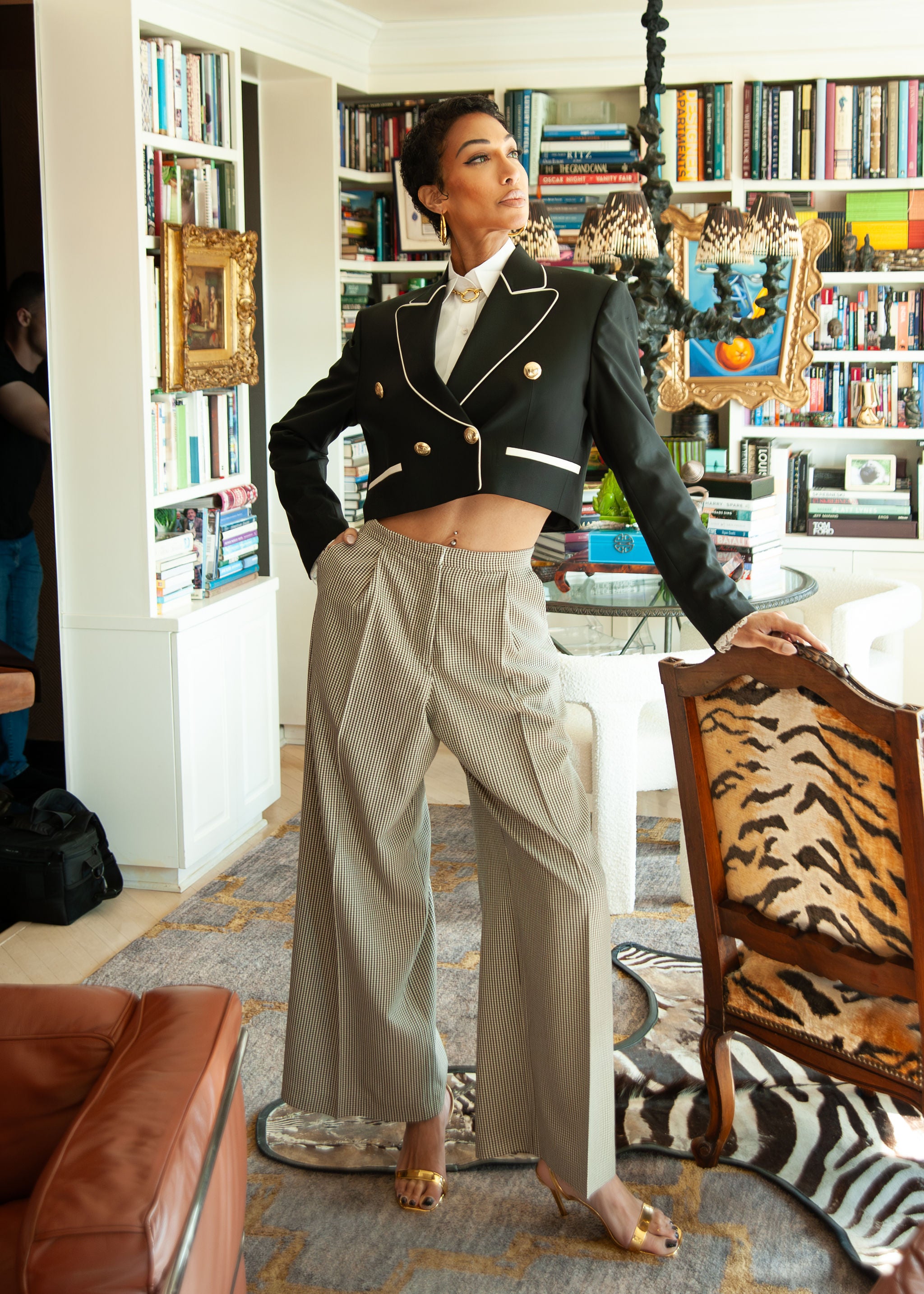
The blazer of today is neither the constructed architecture of the 1980s nor the spare precision of the 1990s. It is generous in its proportions, relaxed in its attitude, double-breasted in its confidence. It adapts entirely to the woman wearing it, because the woman wearing it knows exactly what she is doing.
This is the lineage that informs the blazers at the centre of From Paris to London by UNROOTD CHAPTRS. The Buckingham, cut in Prince of Wales check virgin wool. The Mayfair, in pure black wool with a wide white silk collar. The Chelsea, in houndstooth, oversized and easeful. Each one is double-breasted. Each one is made in France, in our atelier in Lyon.
Sixty years after Le Smoking, the suit remains fashion’s most sustained argument. It is not a homage to any single moment in this history. It is the next sentence in a very long argument — one that has been building, decade by decade, since a woman first put on a jacket that was not made for her and made it entirely her own.
A woman who knows how to occupy a tailored silhouette needs nothing else to make herself understood.