


June 1994. The Serpentine Gallery in Hyde Park. Princess Diana arrives in a black off-shoulder dress by Christina Stambolian, a dress she had reportedly owned for some years and set aside, then reconsidered in the hours before the event. Her husband appeared on British television the same evening, confessing to infidelity in an interview watched by millions. What Diana wore to that gallery, on that particular night, was not a coincidence. It was a decision. And like all decisions made at the right moment, it became something larger than itself.
The dress did not make a statement. It was a statement. Short, black, off-shoulder, fitted, confident without effort: a silhouette that did not ask permission and did not require explanation. The photographs taken that evening have been reproduced and studied for more than thirty years, not only because they capture a famous woman at a famous moment, but because they demonstrate, with particular clarity, something that fashion has always known and the wider world periodically rediscovers: clothes carry meaning, and that meaning can be deployed with extraordinary precision.
The History Behind the Moment.
Diana was not the first woman to understand this. The history of women's fashion, read carefully, is largely a history of women using clothes to say what social convention would not otherwise allow them to say.
In the early twentieth century, the suffragettes wore white to marches and demonstrations throughout Britain and the United States. The choice was deliberate. White communicated purity and moral seriousness at a time when women campaigning for the right to vote were frequently dismissed as irrational or unladylike. It also created a visual unity that was impossible to ignore in a crowd. The colour was not incidental. It was the argument.
When Marlene Dietrich appeared in trousers in the 1930s, she was not simply making a fashion choice. She was making a statement about who she was and what she refused to be contained by. When Katharine Hepburn wore trousers to the set of her films and refused to change when studio executives objected, she was making the same statement in a different context. The trouser, for women of that era, was not a garment. It was a position.
Yves Saint Laurent's Le Smoking, presented in 1966, belongs in this lineage. So does the power dressing of the 1980s, which placed women in silhouettes that demanded the same spatial authority that men's tailoring had always assumed. So does, in a different register, the rise of the black dress in the late twentieth century as the garment of choice for women who wanted to be taken seriously without wanting to explain themselves.
What a Silhouette Can Say.
The particular genius of clothes as a communicative medium is that they speak without words and are received without the mediation that words require. A woman in a well-cut suit enters a room and the room registers, before anything has been said, that this is a woman who has considered how she wants to be understood. The message is not in any specific garment but in the quality of intention that the garment carries.
Silhouette is the most powerful element of this communication. The shoulder line. The length at the hem. The relationship between the fitted and the oversized, the revealed and the concealed. These are not aesthetic choices alone. They are decisions about proportion and authority and the degree to which a woman chooses to take up space.
The defiance that Diana embodied at the Serpentine Gallery in 1994 was not in any single element of what she wore. It was in the overall act of being completely composed, completely considered, and completely present at a moment when the easiest thing would have been to withdraw. The dress was the expression of that composure. The composure was the point.
Clothes carry meaning, and that meaning can be deployed with extraordinary precision.
Defiance in the Contemporary Wardrobe.
In 2026, the sartorial act of defiance looks different from how it looked in 1994, or 1966, or 1930. The explicit prohibitions are gone, in most contexts. Women may wear what they choose. The act of defiance has therefore become more subtle and, in some ways, more interesting.
In an era of fast fashion, of algorithmic trend cycles, of dressing for content and visibility, the defiant act is to dress for yourself. To choose quality over novelty. To build a wardrobe of pieces with genuine longevity rather than seasonal relevance. To select clothes that carry a point of view rather than clothes that communicate participation in a current moment. To dress, in short, with intention.
This is quiet luxury understood not as an aesthetic category but as an ethical position. The woman who wears a well-made blazer in virgin wool, made in France, in a pattern and cut informed by decades of tailoring history, is making a choice that runs counter to the dominant logic of contemporary fashion. She is not following the algorithm. She is not optimising for visibility. She is dressed for herself, and for the day, and for the particular quality of authority that comes from knowing exactly what you are wearing and why.
A Chapter in That Tradition.
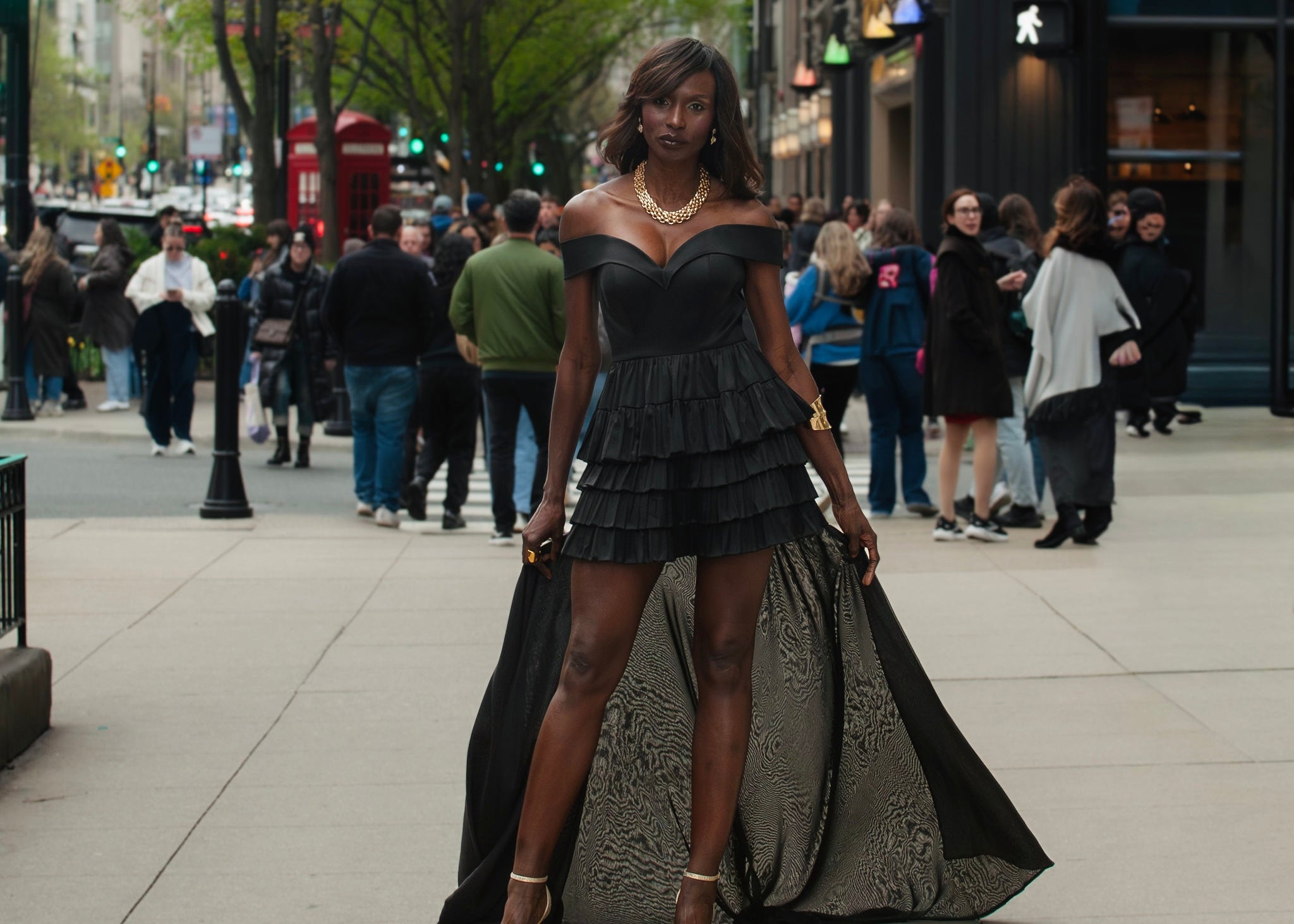
The 1994 Dress from UNROOTD CHAPTRS takes its name from a moment rather than from a person. It is a bustier dress in pure silk, off-shoulder, fitted through the body, with a tiered mousseline skirt and a three-metre detachable train. It was designed as a contemporary articulation of what that moment in 1994 represented: the decision to be composed, beautiful, and entirely deliberate in the face of whatever the room expects.
Every piece from From Paris to London carries something of that same spirit, at different registers and in different contexts. The Bloomsbury Blazer, inspired by the women who walked into rooms and quietly rearranged them. The Camden Noir Skirt, designed for someone who does not ask for permission. The Mayfair Pants, wide-leg and fluid, structured enough to command the room it enters.
Fashion has always been, for the women who understand it most clearly, a form of language. The history of that language is a history of women saying, in the most direct way available to them: I am here. I have decided who I am. I dressed this morning with the full intention of being exactly myself. No more and, emphatically, no less.
Discover The 1994 Dress and From Paris to London at UNROOTD CHAPTRS.